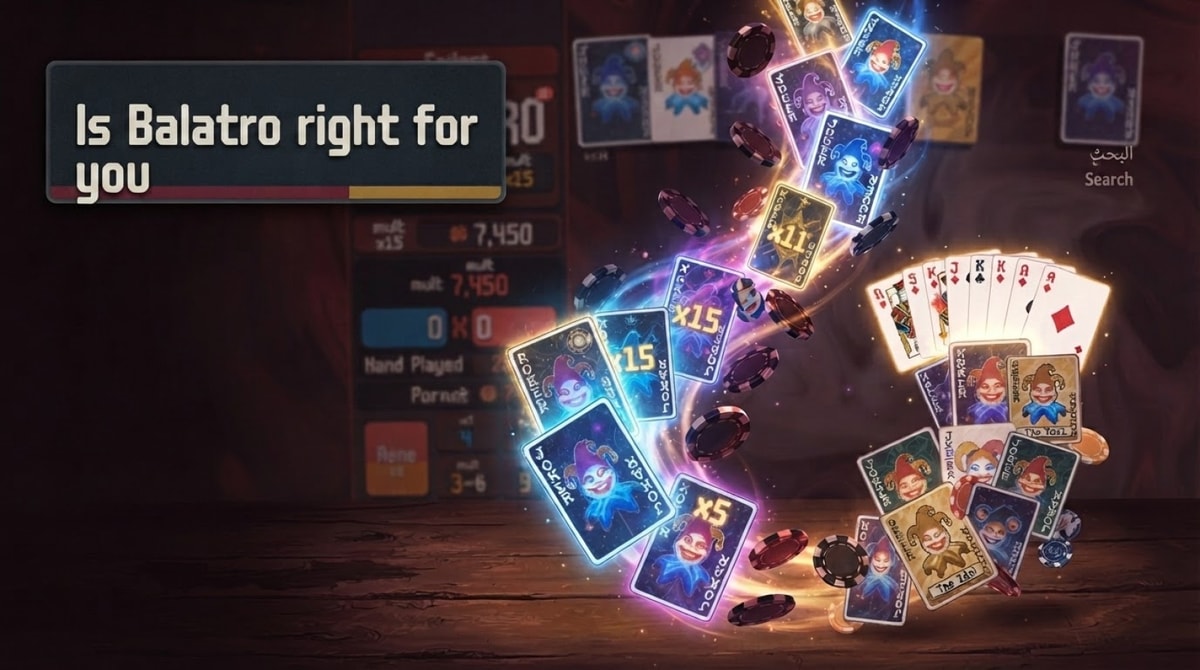
Balatro is worth buying if you want a solo card game built around scoring combos, failed attempts, and the urge to improve your next run. Skip it if you are looking for a story campaign, co-op, or a simulated poker table with opponents and betting.
The important distinction is simple:
- Balatro uses poker hands as its scoring language, then turns them into a roguelike deckbuilding system.
- You are not playing a plot between matches.
- You are trying to make one run’s cards, bonuses, and limited decisions work long enough to beat the next target.
How scoring grows inside a Balatro run
A Balatro run moves through successive rounds called antes. Each ante raises the point target, while your available hands and discards remain limited. That pressure makes every choice matter: spending a discard to search for a better hand may help immediately, but it can leave you with fewer ways to respond before the round ends.

The basic loop is easy to picture. You play a poker-style hand, earn points, manage the remaining hands, and then adjust the deck or bonuses before the next challenge.The opponent is the rising score line, not another person at the table. The bright, readable card layout keeps the hand, modifiers, and Joker effects visible without presenting a 3D casino room to explore.
Hands, discards, and the rising ante
Flushes, full houses, straights, pairs, and other familiar hands provide the starting point for scoring, but the target keeps moving. A hand that clears one round may become too weak later unless your deck and bonuses improve with it. Limited hands punish waste, while limited discards make a poor opening draw a problem to solve rather than an invitation to play endlessly. This structure gives each round a clear question: can your current build reach the next threshold before its resources run out?
How Jokers and Tarot rewrite the score
Jokers, Tarot cards, Planet cards, and related effects alter what a useful hand looks like. One run may reward repeated pairs, while another pushes you toward a different combination because its available bonuses change the value of your cards.The build is the real progression. When a run fails, you do not restart a campaign chapter. You learn which scoring plan stopped working, then begin another run with a different possible route.
If you only know real poker nights
Balatro will feel familiar at first because its point language comes from poker. You still recognize hands such as a flush, full house, straight, pair, and other standard combinations. Those names tell you what pattern to assemble, so a poker fan can understand the first scoring decisions without learning an entirely new vocabulary.

That familiarity stops at the hand list. Balatro has no seated opponent, no bluffing, and no chip betting. The poker layer is abstract points only, with no real-money gambling. You are not deciding whether another player is hiding a stronger hand. You are checking whether your selected cards, Jokers, and other modifiers can produce enough points before the hand limit disappears.
What still feels like poker language
The hand names give each turn a readable goal. A flush means collecting cards of one suit, a full house combines a three-of-a-kind with a pair, and other hands follow the familiar pattern. That foundation helps poker fans read the table quickly, but the score attached to a hand is only the beginning. Bonuses can make a modest-looking combination more valuable than a traditionally stronger hand, depending on the build.
Variety comes from the way these scoring rules interact with the deck. Jokers can reward a repeated hand type, modify a category, or change which cards deserve space in your plan. Tarot and Planet cards add further ways to reshape the run.The interesting question is not whether you can recognize a poker hand; it is whether the hand still fits the bonuses you have collected.
What a real table does that this game never does
A real poker table creates tension through other players. You read betting patterns, watch for hesitation, choose when to fold, and judge how much information your opponents may have. Balatro removes that social contest completely. There is no rival to read, no bluff to call, and no pot to protect. The score target takes the opponent’s place, and the game measures your build against that target.
Anyone wanting a casino-table simulation will not find it here. The clear card layout is designed for tracking points and effects, not for recreating a physical room or a night of poker. Its replay value comes from changing Joker synergies inside a solo run rather than from varied human behavior. That makes Balatro a poor match for players who want multiplayer tension, but a focused fit for anyone who enjoys turning familiar hand patterns into a system of escalating decisions.
Learning speed and interrupted sessions
Balatro is easier to read at the start than its roguelike systems suggest. Card ranks and familiar poker-style hands give beginners a language for the first decisions, but the game quickly adds pressure through ante targets, limited hands, and limited discards. A sloppy discard can leave you short of the required score before you have learned which cards deserve protection.

The learning curve comes from understanding how Jokers, Tarot cards, Planet cards, and other modifiers change the value of an ordinary hand. You are not only asking whether a hand looks good. You are asking whether it fits the scoring plan you are building, whether the next ante will punish that plan, and whether spending a discard now leaves enough flexibility for the next round. That makes the opening friction meaningful rather than obscure.
What a card beginner meets in the first hours
A new player can follow the visible card ranks and hand patterns, then gradually learn why a modest hand with the right Joker setup may beat a stronger-looking hand. The important adjustment is accepting that Balatro rewards a build, not a single lucky deal. If you prefer clear rules that reveal extra layers through repeated attempts, this is a welcoming entry point to the format. If you want every decision explained before it matters, the early losses will feel abrupt.
When a short session works without finishing the run
Rounds give Balatro useful stopping points. You can begin a run, finish a round, and stop without needing a campaign checkpoint to preserve a story chapter. The game does not offer an official average run length, so assigning a minute count would be misleading. Session length changes with decisions, scoring speed, and how far the run survives. The loop often invites a second attempt the same night because a failed build immediately suggests a different route. That is replay stickiness, not a promise of addiction, and readers who dislike repeated retries should treat it as a warning rather than a benefit.
What paying still will not include
Buying Balatro gives you a paid digital game built around solo runs, not a story package or a multiplayer table. Its poker layer uses abstract points and card effects, so there is no real-money betting system. The missing features matter more than the store choice if you are shopping for a campaign or a social mode.
| Question | What Balatro includes | Decision impact |
|---|---|---|
| Story campaign | No deep story campaign or cinematic plot | Skip it if narrative chapters are your main reason to buy. |
| Online or co-op play | No online multiplayer or co-op; runs are solo | It cannot replace a game built around human opponents. |
| Real-money betting | No real-money betting; poker-style scoring is abstract points | The theme is card strategy, not a betting simulator. |
| Official access | Available through official stores on Windows, macOS, Nintendo Switch, PlayStation, Xbox, and Android | Use the store for your platform and avoid unofficial copies. |
On Google Play, the download price is $9.99 as of 14 August 2026. The listing shows a 4.68/5 rating from 27,253 ratings and 1,000,000+ installs, with Playstack named as the developer. Prices on Steam, Nintendo eShop, PlayStation Store, and Xbox Store can change by region and sale.
Pay for it in this case only
Pay for Balatro if you want solo nights built around creating a combo, watching a scoring plan take shape, and starting again after a loss. The one-time digital purchase pays for repeated runs and the decisions inside them, not for story chapters that unlock over time.
Skip Balatro if you want a campaign, co-op, online competition, or table poker against a real opponent. Its familiar cards are the entry point, but its destination is a single-player system of escalating targets and retries. For that specific play style, the purchase makes sense; for story-led or social play, choose a different kind of game.


Comments
No comments yet. Be the first to share your thoughts.