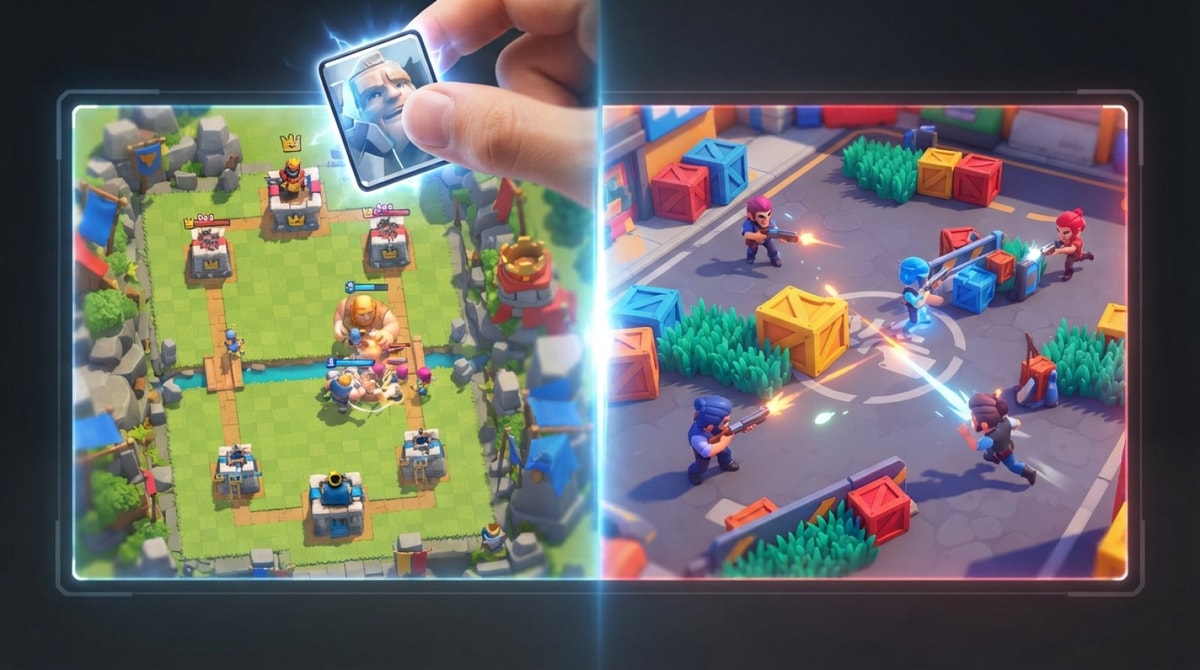
Choose Clash Royale if you want deep head-to-head card strategy, and pick Brawl Stars if you want real-time multiplayer action with direct manual controls. Both free-to-play mobile titles from Supercell rank among the most popular competitive games on iOS and Android, but they demand entirely different skill sets from players.
Clash Royale centers on deck construction, precise card timing, and resource tracking on a two-lane tower defense grid. Brawl Stars relies on twin-stick movement, manual aiming, and spatial awareness in fast-paced top-down battle arenas. Understanding how their controls, session lengths, team structures, and progression systems differ ensures you invest your time in the game that truly aligns with your competitive style.
Evaluating their core mechanics, game modes, progression curves, and session lengths makes it clear which title belongs on your device.
Quick Decision Guide: Which Game Fits Your Preferences?
Comparing Clash Royale and Brawl Stars is not a matter of finding an absolute winner, as both games deliver refined competitive experiences tailored to different mindsets. Clash Royale caters directly to tactical thinkers who enjoy deliberate 1v1 resource duels where every card interaction matters. Brawl Stars appeals to players looking for instant arcade combat, twin-stick movement, and fluid cooperative multiplayer matches.
- Choose Clash Royale if you prefer solo 1v1 strategy, lane defense management, deck synergy, and calculated counter-plays.
- Choose Brawl Stars if you prefer direct hero control with virtual joysticks, fast-paced 3v3 team modes, skill-shot aiming, and quick action.
- Choose Clash Royale for tactical resource management where elixir efficiency decides victory across a structured arena grid.
- Choose Brawl Stars for dynamic objective-based arenas like Gem Grab and Brawl Ball, alongside casual battle royale modes like Showdown.
Both games offer deep progression curves, collectible unlockables, and frequent balance updates. If you want a chess-like battle of wits on a fixed arena map, Clash Royale provides structured analytical depth. If you prefer active dodge-and-shoot skirmishes with full directional control, Brawl Stars delivers an immediate arcade challenge.
Core Gameplay and Control Mechanics
The fundamental distinction between Clash Royale and Brawl Stars lies in how you interact with the playing field. One relies on tactical card placements and automated unit behavior, while the other demands continuous manual control over movement and combat.
Clash Royale: Strategic Card Deployment and Elixir Management
In Clash Royale, matches take place on a two-lane arena divided by a middle river. You do not steer individual characters or trigger basic attacks manually once units are deployed. Instead, your primary task involves managing a regenerating elixir gauge, building an eight-card deck, and timing deployments to counter enemy advances while protecting your crown towers. Managing elixir generation rates during standard time and double elixir periods requires constant tactical awareness, forcing players to balance offensive surges against defensive conservation. Success depends on tracking opponent card rotations, building elixir advantages, and placing troops on precise tiles rather than testing physical reaction speeds.
Brawl Stars: Twin-Stick Combat and Direct Control
Brawl Stars shifts focus to direct mechanical execution using virtual touch controls. Players maneuver their chosen character across top-down maps with an on-screen movement joystick while using a second joystick to aim basic attacks and charges. Positioning behind terrain, manually leading skill shots, and dodging incoming fire replace deck building, placing personal reflexes and spatial positioning at the center of every firefight.
Game Modes, Session Length, and Team Dynamics
Beyond control schemes, the two titles organize team dynamics and session timing differently. Clash Royale was crafted primarily as a high-stakes 1v1 duel where total responsibility for winning or losing rests on your solo choices. Standard matches last between three to five minutes, creating concentrated bursts of tactical focus. While 2v2 modes exist for casual play, the core competitive ladder centers on individual competition.
Brawl Stars: Cooperative Teamwork and Mode Variety
Brawl Stars prioritizes team multiplayer through standard 3v3 game modes. Match types such as Gem Grab, Brawl Ball, Knockout, and Bounty demand clear role distribution, spatial coordination, and quick communication between tank, damage, and support characters. Additionally, solo and duo Showdown options provide a battle royale experience when playing without a squad.
Match Pacing and Time Commitments
Average match lengths in Brawl Stars generally fall between two to three minutes, making matches slightly faster and more flexible than Clash Royale. The rapid pace allows players to quickly switch characters, test alternative team compositions, or hop between game modes during short breaks. This fast-paced structure minimizes session friction, making it easy to finish multiple matches within a short daily play window without high strategic burnout.
Progression Systems and Monetization Impact
In Clash Royale, card levels affect unit health, attack damage, and critical interaction thresholds during battle. Upgrading cards requires gathering duplicates through reward chests and spending gold, along with leveling up crown towers to boost base health and damage. Facing an opponent with higher card levels alters core unit interactions—a higher-level spell might eliminate a troop that would survive at equal tournament levels. This level reliance creates a statistical barrier in ladder play, making account upgrades a significant factor alongside card placement until players compete in level-capped tournament formats.
Clash Royale Card Levels and Tower Power
Upgrading cards alters damage interactions directly, providing higher-level units clear advantages in head-to-head trades across standard ladder matches. Tower levels further scale base hit points and arrow attack speed, meaning player level progression directly impacts how efficiently your arena towers clear oncoming swarms.
Brawl Stars Brawler Unlocks and Power Points
Brawl Stars centers progression around unlocking new Brawlers and upgrading them using coins and Power Points. Increasing a Brawler's level unlocks gameplay additions like Gadgets, Star Powers, and Gears, which add active abilities and passive statutory enhancements. While upgraded stats give Brawlers an advantage in direct trades, aiming skill, cover utilization, and team positioning remain crucial for winning encounters. Competitive modes apply normalized power limits, helping maintain baseline balance where mechanical execution stays central to match outcomes.
Player Profile and Playstyle Mapping
Deciding between these Supercell games comes down to whether your strength lies in long-term strategic resource management or immediate mechanical reaction speed.
Strategic Planning and Deck Mastery
Clash Royale rewards players who enjoy managing resource economies and analyzing deck matchups. Achieving high ranks requires tracking elixir usage, anticipating enemy card cycles, and making precise tile placements to drag incoming tanks into range of defensive towers. The learning curve emphasizes memory, discipline, and understanding positional advantages before committing high-cost cards. Analyzing replay footage and refining card synergies allows analytical players to consistently improve win rates through tactical discipline rather than physical finger speed. Players who enjoy collectible card games or tactical tower defense titles will find this deliberate decision-making process deeply satisfying.
Aiming, Movement, and Reaction Speed
Brawl Stars directs its skill curve toward mechanical dexterity and spatial awareness. Players must constantly control movement, aim projectiles, predict target paths, and coordinate special abilities with teammates during fast arena engagements. The learning curve focuses on mastering character attack ranges, using cover effectively, and controlling map zones. If you prefer top-down action titles, twin-stick shooters, or hero-based team brawlers, the immediate feedback of Brawl Stars offers a compelling match.
- Choose Clash Royale if: You excel at managing resources, building balanced decks, reading enemy rotations, and executing strategic counter-plays.
- Choose Clash Royale if: You prefer solo 1v1 ladder competition where winning depends entirely on your own tactical decisions.
- Choose Brawl Stars if: You prefer direct joystick movement, manual skill aiming, team coordination, and instant action.
- Choose Brawl Stars if: You want fast two-to-three-minute multiplayer matches across diverse game modes with friends or solo.
Final Verdict and Recommendation
Your decision comes down to whether you prefer structured card strategy or real-time action controls.
Select Clash Royale if you want a purely head-to-head tactical strategy game where success rests on elixir management, card deck synergies, and precise unit placement. It stands as the superior pick for analytical gamers who enjoy deep competitive ladder play, defensive tower management, and solo strategic dueling without relying on team-mates.
Select Brawl Stars if you want dynamic, team-focused action with direct dual-stick movement and manual skill shooting. It is the definitive choice for players seeking fast three-minute multiplayer rounds, diverse arcade game modes, and direct twitch-based combat mechanics.


Comments
No comments yet. Be the first to share your thoughts.