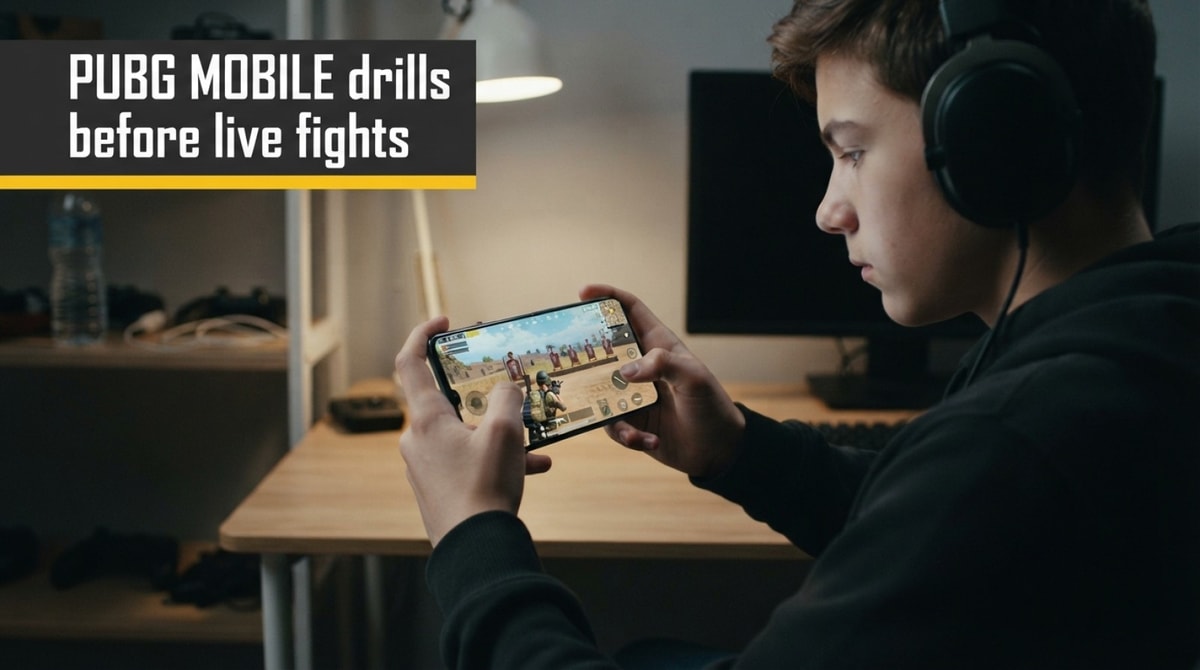
Improve at PUBG MOBILE by isolating one fight problem at a time, then repeating a drill you can score instead of simply playing more matches. Start with tracking and recoil control, adjust one sensitivity layer only when the result is clear, and use fight selection to reduce avoidable deaths.
The useful target is not a promised rank jump. It is a steadier reticle, more controlled movement while shooting, and better choices before you expose yourself to a fight.
What makes a PUBG MOBILE drill worth your time
A good PUBG MOBILE drill has a narrow purpose, a repeatable setup, and a result you can recognize without guessing. It should show whether one habit is improving, not give you another reason to queue for a match. Tie the drill to a death pattern you have already noticed, then avoid changing several controls at once. Specialist gaming reviews generally describe PUBG MOBILE as strong overall while warning that its phone controls take time to master, so a slow, measurable routine is more useful than a promise of instant improvement.
Match the drill to the death pattern
Choose one problem before you start. If missed sprays end your fights, work on keeping the reticle on the torso while firing. If you lose rooms, practise entering with your crosshair at likely chest height and controlling the first close-range burst. If third parties finish you, rehearse breaking contact, moving to cover, and checking the next angle before re-engaging. Playing more matches without naming the pattern gives you more repetitions of the same mistake, not better practice.
Make every session repeatable and scoreable
Use a setup you can recreate each session. In training mode, count torso hits on a still bot over the same short burst, or record how many fights you deliberately chose rather than fights that found you. The score does not need to be sophisticated. It only needs to stay consistent. Reject routines that require someone else’s sensitivity code or promise a fast rank jump. Your controls, screen, thumbs, and movement habits are not identical to another player’s.
- Stable frames come first: lower distracting effects when the phone stutters before blaming your aim.
- One death pattern per session: do not mix missed sprays, room entries, and third-party decisions into one vague score.
- One clear result: stop when you can identify what improved or what still breaks down.
Beginner camera, ADS, and gyro layers
Set up sensitivity as three separate layers rather than hunting for one universal number. Camera sensitivity controls how quickly your view moves when you look around, ADS sensitivity shapes movement while aiming and firing, and gyro sensitivity uses device tilt for fine corrections. Change only one layer in a session, keep the other two unchanged, and repeat the same tracking task so you can link the result to that adjustment.

| Layer | If it is too high | If it is too low | What to observe |
|---|---|---|---|
| Camera | The view overshoots the target when you turn or check an angle. | You cannot keep up with a moving target or turn into a new threat. | Move across a fixed point and stop the reticle on it. |
| ADS | Your spray swings past the torso during a correction. | The reticle trails behind a strafe while you are firing. | Track the torso through a chosen, repeatable burst. |
| Gyro | Small phone tilts create shaky or excessive corrections. | Tilting the phone does not help finish fine corrections. | Use it for small adjustments after your thumb places the reticle. |
Touch aiming can become messy when you move and shoot at the same time, a complaint repeated across player discussions, app-store reviews, and specialist coverage. Keep the layout simple enough that firing, movement, and camera actions do not compete for the same thumb. Retune after changing phones, moving from thumbs to claw controls, or changing graphics and frame rate, because those changes may alter how the input feels. This setup pass suits players whose reticle repeatedly jumps off the torso. If you have not done tracking practice yet, skip a week of slider tweaks and build that basic control first.
Aim-drag work in Training Ground
Open Training Ground in PUBG MOBILE and choose one weapon class for the session. Start with still targets, then drag across them using the same thumb movement you use in a real fight. The first useful result is not a high damage number. It is keeping the reticle on the torso without repeatedly lifting and resetting your aim.

Once the motion feels controlled, repeat it against moving targets. Follow the target, correct gently when the reticle slips, and avoid turning each miss into a wild camera swing. Players and reviewers commonly describe PUBG MOBILE as having solid shooting, decent graphics, and smooth performance on many phones, but that smooth gunplay only helps when your own movement stays controlled. End the drill when you can recover from a miss without spinning the camera or losing the target completely.
Moving from Training Ground into Classic
Bots do not shoot back, reposition with a teammate, or draw another team after a loud fight. A clean bot run shows that your thumb path is improving, not that you are ready for every Classic engagement. Carry the skill into one live match with a simple transfer rule: use the same weapon class, pre-aim one likely angle, and focus on recovering after the first missed bullets. Change only one variable at a time. If the reticle stays near the torso but the fight still falls apart, look next at cover, timing, or awareness rather than aim dragging.
Close-range fights you stop throwing
The first second of a close fight needs a plan. Pre-aim the doorway, window, or rock edge before exposing your body. Fire a short burst, check whether the opponent is still in your crosshair, then reset behind cover instead of holding a spray in the open. That reset gives you another decision point and stops a small miss from becoming a full magazine fired into empty space.
Inside a room, hipfire can beat ADS when the distance is extremely short and the opponent is crossing your screen quickly. Use ADS when the angle is wider or the target has created enough space for controlled tracking. Choose the option that lets your weapon start dealing damage without giving up too much movement.
Peek timing before you spray
Do not reload in the open after a knock. You may have won the first exchange, but another team could hear the shots and footsteps. Move behind cover, reload when the angle is safe, and listen before taking the next peek. The drill is working when you stop treating every knock as permission to chase.
Drops, high ground, and refusing a fight
Positioning starts before your boots touch the ground. Choose a drop where you can loot enough to fight quickly instead of landing at a famous compound you cannot clear before the first gunfire. Aim for a usable weapon, ammunition, healing, and a route toward cover. A crowded landing can sharpen fast decisions, but it is a poor place to blame aim when you had no time to prepare.

Move toward cover that can still protect you after the next zone pull. A roof may offer a clear view, but if it sits outside the circle, it can become a trap that forces a late, exposed rotation. Use this take-or-leave check before committing:
- Take the fight when you have cover, useful sound information, and a full magazine ready.
- Leave the fight when another team is arriving, your healing supplies are nearly gone, or the zone has made your position unsafe.
- Protect the next move by rotating before the open field becomes your only route. A late rotation through open ground can end a strong early game.
This rule helps if poor timing causes more deaths than missed shots. Refusing a bad fight is not passive play. It preserves health, information, and the chance to choose the next angle.
What the store numbers say about the device you are training on
PUBG MOBILE, published by Level Infinite, has passed 1,000,000,000 installs on Google Play and holds a rating of 4.32 out of 5 from 48,610,097 reviews. We read the listing on 31 August 2026.
Forty-eight million reviews on a billion installs tells you something practical about aim training: the matchmaking pool is enormous, so it will keep placing you against players at roughly your own level no matter how much you play. Your win rate stays flat unless you deliberately change one habit at a time, which is exactly why the drills in this article each isolate a single decision (thumb path, movement while firing, or when to take the duel) instead of asking you to fix everything at once. The other practical consequence of that install base: the game ships settings tuned to your specific handset on first launch, so before blaming your sensitivity, check whether you raised the graphics preset above what the game picked for you.
Measure each habit change in the Training Ground rather than by volume. Give each drill 10 minutes and one variable, then take it into a live match before you change anything else.
The drill that matches how you die
Choose this week's drill from your usual death pattern, not from a streamer's routine. If you lose rooms and the 1v1s you start, run Training Ground aim dragging and the peek-timing drill. If the zone or third parties end most matches, use the drop and refuse-fight checklist. Each choice targets a different breakdown, so mixing them into one long session makes the result harder to read.
Track one number for two weeks: fights you chose versus fights that found you, or how often you survive past the first circle. Do not use rank as your only score. Players have reported frame drops, heating, and fast battery drain on some devices. If heat is affecting frame stability, stop the session. Short, focused sets are more useful than tilted queues on a phone that is losing performance.


Comments
No comments yet. Be the first to share your thoughts.